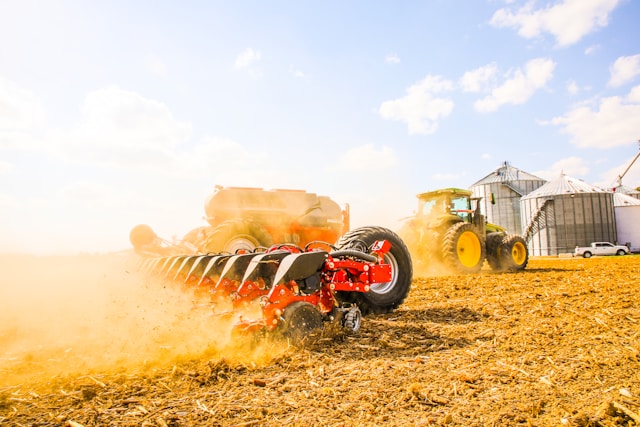
The primary source of economic stress in Australian organic farming is weed management, and a 2024 meta-analysis of 32 studies and over 400 observations verified that organic systems consistently report higher weed densities than conventional, which is a gap that impacts crop competition, harvesting efficiency, and production costs at all scales. Since synthetic herbicides are not allowed on certified organic farms, mechanical cultivation has become the mainstay of how they survive.
The Weed Pressure Problem In Numbers
In organic systems, weeds are not just a nuisance: they are the single largest contributor to yield loss in the sector. For example, weed management is the most commonly reported production constraint in Australian surveys of organic vegetable and herb growers. The human labour needed to manage that pressure manually is often one of the highest operating costs that an organic farm will have, which is why mechanised solutions are so popular. Rotary hoe hire is a viable solution for farms that require the efficiency of machinery on the field without the cost of owning equipment.
The economic context frames how rotary hoeing should be assessed. The answer is not whether it is better than doing nothing (it clearly is), but whether it can meet the level of reliability and spectrum of control that herbicide programs offer in conventional systems, and whether the cost structure of mechanical cultivation is viable across the range of conditions faced by Australian organic growers. The research provides answers to both questions, and they are more nuanced than the advocates of rotary hoeing are inclined to admit.
What the Research Shows About Weed Reduction Rates?
A two-year US Department of Agriculture study showed that one pass with a rotary hoe reduced total weed density by 69% in one season and 49% in another, and a second pass reduced density by 33% under ideal conditions enough to make a difference to crop competition during the first few weeks of growth when weeds are at their most destructive, and enough to reduce seed production from major weed species by 80% to 95%.
Those numbers are indeed encouraging but with a caveat not advertised in the headline figures. The reason that timing is not a preference but a requirement for rotary hoeing is that the method is most effective against small, newly emerged weeds; larger or well-established weeds survive cultivation. Herbicides offer a greater treatment window; they can be applied over a wider range of weed sizes and still achieve reliable control. Regardless of how efficient the equipment becomes, this flexibility is one of the practical advantages that mechanical cultivation cannot easily replicate.
The Reliability Gap Between Mechanical and Chemical Control
Chemical herbicides have consistently achieved 90% control rates or higher across a broad spectrum of weed species and field conditions, while rotary hoeing under ideal dry conditions comes close to that figure (a study of inter-row cultivation found about 90% weed kill in favourable conditions, whereas total weed mortality dropped to about 78% following rainfall, a 12-percentage-point swing driven by weather, which is at the heart of the reliability problem with mechanical cultivation as a stand-alone weed control strategy that growers can plan around in conventional systems).
Soil Health: The Benefit and The Cost That Often Gets Overlooked
Synthetic herbicides are eliminated, eliminating chemical residues and preventing the evolution of herbicide-resistant weed populations a growing problem in conventional systems around the world and one that organic growers are shielded from by their structural protection. Those are real long-term benefits. But rotary hoeing is not cost-free from an environmental perspective. For example, research into mechanical weed control in organic rotations concluded that cultivation can change soil moisture dynamics, influence nitrogen availability, pose a greater risk of erosion on vulnerable soils, and speed up organic matter decomposition when overused.
In organic farming systems, the straightforward reality is that rotary hoeing is a valuable part of a weed management system, not a weed management system in itself. Those farms that have the most success with it use it in conjunction with crop rotations, mulching, cover crops, and with timing treating mechanical cultivation as one layer of a more complex system, rather than the entire solution. For organic growers trying to manage the weed pressure that comes with chemical-free production, that combination is where the evidence tends, and where the most productive and profitable operations appear to be.